


On October 30, 1935, the Boeing Model 299 lifted off the runway at Wright Field in Dayton, Ohio, climbed to 300 hundred feet, stalled and crashed. The fireball killed two of the five crew members, including the pilot, Major Ployer Peter Hill. The plane, a four-engine prototype bomber bristling with machine guns, was supposed to win Boeing the Army Air Corps contract. Instead, it became a smoking wreck less than a mile from the runway.
The investigation was quick. The crew had forgotten to release the gust locks, a mechanism that held the control surfaces rigid while the plane sat on the ground. Leslie Tower, Boeing’s chief test pilot sitting in the observer seat, saw the error and tried to reach the locks. He died of his burns nineteen days later.
The consensus was that the Model 299 was “too complex to fly.” Two of the most experienced test pilots in the country had forgotten a single step, and it killed them. The reasonable conclusion was that the plane demanded more than human attention could provide.
But a small group of Boeing engineers and test pilots refused that conclusion. They did not argue that future pilots should try harder, concentrate more or summon greater discipline in the cockpit. They made a piece of paper. A short list of steps, taxi, takeoff, landing, that no pilot could skip, no matter how skilled or experienced. The preflight checklist. With that single sheet in hand, Boeing and Air Corps pilots flew the subsequent twelve B-17s a total of 1.8 million miles without a single accident. The Army eventually ordered nearly 13,000 of the aircraft. The checklist became mandatory in all of military aviation and, soon after, in commercial flight worldwide.
The lesson embedded in that crash is older than aviation and more consequential than any one plane. The Model 299 was not too complex to fly. The fix was not better pilots. It was a system that made the gap between a good pilot and a perfect pilot irrelevant.

in the possession of Mrs. Anthony Trollope
Anthony Trollope: The clock and the word count
Thirty years before the Model 299 hit the dirt at Wright Field, a different kind of machine was running flawlessly in a small English house. Every morning at 5:30 AM, an old groom brought a cup of coffee to Anthony Trollope, one of the most productive novelists in the English language. The groom was paid five pounds a year for this duty. He was never once late.
Trollope sat at his desk, placed his pocket watch in front of him, and wrote. Two hundred and fifty words every quarter of an hour. Every fifteen minutes, he checked his count. In his autobiography, he described the arrangement with mechanical precision:
“It was my practice to be at my table every morning at 5:30 AM; and it was also my practice to allow myself no mercy.”
If he finished a novel before his three hours were up, he pulled out a fresh sheet of paper and started the next one.
The output, over 35 years was 47 novels, 17 works of nonfiction, 2 plays and dozens of short stories and articles. All of this while holding a demanding full-time position as a post office inspector, a job that required constant travel across the British Isles. (He also hunted twice a week.)
Trollope did not agonize over writer’s block or wait for the right mood or the right alignment of feeling and craft. He had a watch and a word count. He had a servant who would not let him sleep. His system was so airtight that it rendered motivation almost beside the point. Whether he felt like writing at 5:30 AM was irrelevant. The coffee was already at the desk and the clock was already ticking.
He was, in every sense, the Victorian equivalent of the Boeing checklist. And like the checklist, his method was staggeringly effective while being profoundly unglamorous.
Willpower: The muscle that wasn’t
For most of the 21st century, the dominant scientific story about willpower was that self-control is a limited resource, like fuel in a tank. Use it up resisting chocolate in the morning, and you’ll have less left for resisting cigarettes in the afternoon. The theory was called ego depletion, and it was introduced in a landmark 1998 paper by social psychologist Roy Baumeister and colleagues at Case Western Reserve University.
The foundational experiment was simple. Participants sat in a room that smelled of freshly baked chocolate chip cookies. Some were allowed to eat the cookies. Others were told to eat radishes instead, leaving the cookies untouched. Then both groups were given unsolvable puzzles. The radish-eaters gave up on the puzzles far sooner than the cookie-eaters. The metaphor practically sold itself: willpower is a muscle. Exert it, and it fatigues.
By 2010, a meta-analysis seemed to confirm the theory across nearly a 100 articles and 200 studies, estimating a moderate-to-strong effect. In 2011, Baumeister and journalist John Tierney published the book Willpower, a bestseller that became a cornerstone of the self-help industry. Ego depletion was not merely an academic finding. It was the scientific origin story for an entire worldview and told millions of people that their failures of self-control were not moral failures but resource failures. You didn’t need more character. You needed better resource management.
Then the replication crisis arrived.
In 2016, Hagger, the author of that supportive meta-analysis, led a pre-registered replication study across 23 laboratories with 2,141 participants. The result: the ego depletion effect was roughly zero.
Michael Inzlicht, a psychologist who had spent years refining ego depletion theory, described it this way:
“I felt like a fraud. Ego depletion, the once-famous idea that self-control relies on a finite resource that can be depleted through use, wasn’t real.”
Baumeister and his supporters have not conceded. A 2024 paper argued that the depleting tasks in the replication studies were not long or strong enough. But the scientific consensus has moved. The shining theory that willpower behaves like a muscle is, at best, a fragile effect that appears only under conditions so specific that no one can reliably reproduce them.
What’s left in its place is something less dramatic but more useful.

Habits as autopilots
Wendy Wood, a psychologist who spent three decades studying habits, was assembling a different picture while ego depletion was having its moment. Her diary studies in which participants reported what they were doing and thinking at hourly intervals, produced a finding that is deceptively simple. About 43 percent of what people do every day is performed automatically, in the same context, usually while thinking about something else entirely.
43% of human life runs on autopilot, cued by locations, times of day and sequences of prior actions.
“Most people don’t think that the reason they eat fast food at lunch is because these actions are cued by their daily routines. They think they’re doing it because they intended to eat then or because they like the food.”
If nearly half of daily behaviour is triggered by environmental cues rather than conscious decisions, then the heroic model of willpower, in which a resolute self overcomes temptation through sheer force, describes at most half the picture. And it describes the harder, less reliable half.
Wood’s research showed something else that cuts against the willpower narrative. When participants were depleted by taxing tasks, they didn’t collapse into random behaviour. They defaulted to their strongest habits. Depletion increased the probability of choosing a habit, whether healthful or unhealthful, by about 31%. The depleted self doesn’t go haywire. It follows the groove.
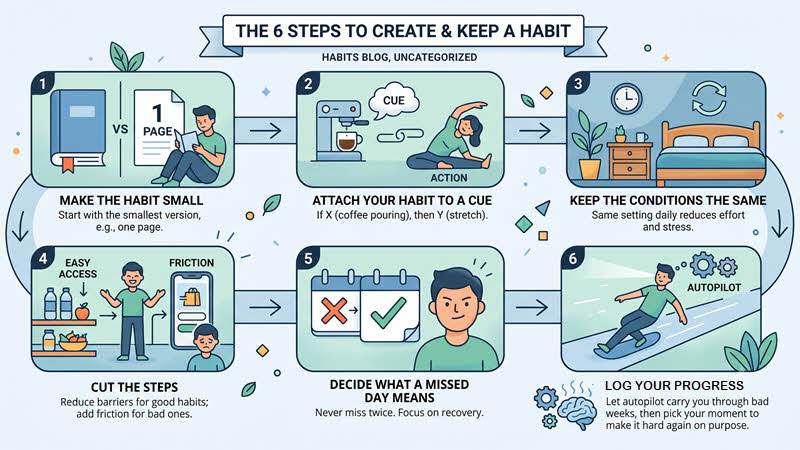
This is the insight that ego depletion missed. You do not need to build a bigger engine of will. You need to lay better tracks.
Implemention intention: The if-then trick
The track-laying approach has its own rigorous research programme. In 1993, psychologist Peter Gollwitzer introduced the concept of implementation intentions: simple if-then plans that specify when, where and how you will act on a goal. Not “I will exercise more” but “If it is Monday at 7 AM, then I will put on my running shoes and go to the park.”
The distinction is not trivial. A 2006 meta-analysis across 94 independent studies and more than 8,000 participants found that implementation intentions produced a medium-to-large effect on goal attainment: d = 0.65. In a 1997 study difficult goals were completed about 3 times more often when participants had furnished them with implementation intentions.
Gollwitzer described the mechanism with a phrase that could serve as an epitaph for the willpower model:
“Implementation intentions work by passing the control of one’s behaviour on to the environment.”
Instead of relying on the self to recognise the right moment and summon the will to act, you pre-load the decision into a situational trigger. The environment does the remembering and the initiating. The self is, to a remarkable extent, off the hook.
This is what Trollope did with his watch. This is what Boeing did with its checklist. This is what every system does when it works. It takes the critical action out of the domain of conscious effort and locks it to a cue, a sequence, a structure that fires whether you feel like it or not.
A $46 billion industry selling motivation
Every January, roughly 40-45% of Americans make New Year’s resolutions. By February, about 80% have abandoned them. By year’s end, fewer than 10% report success. The second Friday in January has earned an unofficial name: Quitter’s Day.
Millions of people, year after year, set goals fuelled by motivation, attempt to execute them through willpower, and fail on roughly the same schedule. The experiment has been run at civilisational scale, with a sample size in the hundreds of millions, and the result is the same.
“Motivation, on its own, is not a reliable engine for sustained behaviour change.”
Yet the global self-improvement market was valued at approximately $46 billion in 2025, projected to reach $90 billion by 2034. The U.S. market alone accounts for $12 billion, spanning motivational speakers, coaching, apps, books, audiobooks, seminars and weight-loss programmes. The top motivational speakers in the United States generate an estimated $350–400 million annually. Self-help book sales have roughly tripled since 2000.
“The industry isn’t selling systems. It’s selling the feeling of being about to change. It’s selling January 1st, again and again.”
There is nothing wrong with motivation as kindling. The problem is that the industry treats it as fuel. You don’t buy Headspace to build an if-then plan. You buy it to feel like the kind of person who meditates. The purchase is the peak. The subscription auto-renews, but the habit doesn’t.

Odysseus and the rope
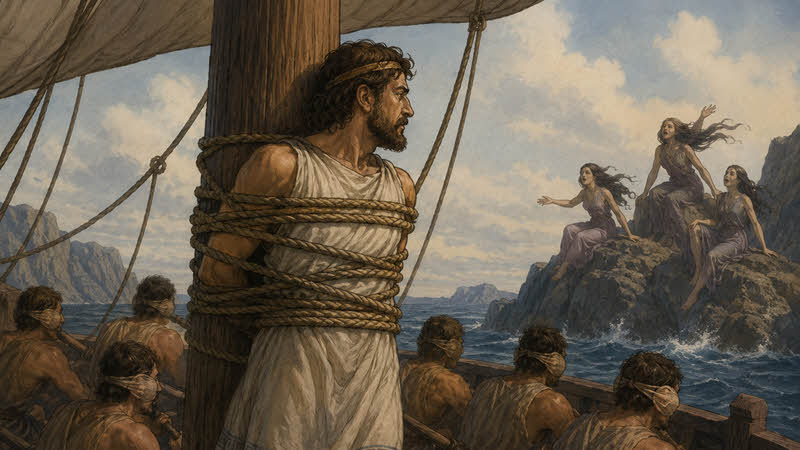
The oldest literary depiction of this problem sits in Book XII of Homer’s Odyssey. Odysseus knows he must sail past the island of the Sirens, whose voices lure every passing crew to shipwreck on the rocks. He wants to hear the song. He also knows, with the cold clarity that separates him from every dead sailor before him, that his willpower will not hold.
So he builds a system. He orders his crew to plug their ears with beeswax. He has them tie him to the mast.
“No matter how I beg, no matter how I plead, do not untie me. Row harder.”
When the song reaches him, he screams. He thrashes. He begs his men to release him. But they lash him tighter and the ship passes. Odysseus survives, not because he had more willpower than other captains, but because he was wise enough to know he didn’t.
The behavioural economist Jon Elster formalised this as precommitment:
“A freely made decision at time one that binds the self at time two.”
The Ulysses pact, as it’s now called, appears in everything from psychiatric advance directives to savings accounts with withdrawal penalties to website-blocking apps that lock you out of Twitter for four hours. The mechanism is always the same. You design the constraint while calm and the constraint holds while you’re not.
Homer had the core insight 3000 years ago. Odysseus didn’t need more willpower. He needed rope.
How to start: Systems need to be made
The first morning Trollope dragged himself to the desk at 5:30, before the habit had grooved itself into the bone was willpower. The decision to hire the groom, to buy the pocket watch, to commit to the word count, all of that required an initial act of deliberate will. The checklist does not write itself. Someone had to sit down after the Model 299 crash and list the steps in the right order, and then every pilot had to choose, at least once, to trust the paper over their own memory.
Gollwitzer’s implementation intentions work partly because they convert a goal intention into a specific plan, but forming the plan is itself a an act of willpower. You must sit down and write “If it is Monday at 7 AM, then I will run.” That requires a moment of execution and deliberate attention. Something that looks suspiciously like willpower. The research shows that once the if-then link is formed, action becomes more automatic. But first the system need to be made by you.
This is the ignition problem. Systems bypass the need for daily willpower, yet they demand a concentrated burst of it at the outset. Every routine has a runway. Every habit has a first week that runs on raw discipline. Odysseus had to issue the order before the Sirens were audible. If he’d waited until the song started, no order would have been given.
And there is a darker complication. Systems can calcify. The same automaticity that frees you from the daily grind of decision-making can trap you in patterns you no longer need. If 43 percent of daily action is habitual, then 43 percent of daily action is also unreflective. Strong habits persist even when goals change. The groove keeps running after the destination has moved. An airline pilot who follows an outdated checklist is more dangerous, not less, than one who’s thinking on the fly.
Worse still: the “systems beat willpower” message has itself become a motivational product. James Clear’s book, Atomic Habits, which has sold over 20 million copies worldwide, has as central claim:
“You do not rise to the level of your goals, you fall to the level of your systems.”
The claim is precise, evidence-informed, and correct. It is also packaged in the exact emotional register of the motivation industry it aims to transcend: inspirational chapter titles, quotable one-liners, a promise that small changes will produce remarkable results. The book is a system for building systems, marketed as a shot of motivation. The snake eats its tail.
This does not invalidate the claim. The fact that even the most robust evidence for systems thinking gets digested by the motivation industry, repackaged as another purchase that feels like progress, reveals just how deep the preference for willpower runs.
We don’t just struggle to build systems. We struggle to want them. We keep reaching for the feeling of heroic effort, even when the data shows that heroic effort is the least reliable path.
The bottom line
In 1883, a year after his death, Anthony Trollope’s autobiography was published. In it, he revealed everything: the groom, the pocket watch, the 250 words per quarter, the mechanical accounting of his output. He described writing as a trade and listed his earnings from each novel in a table, as if it were no different from shoemaking
The literary establishment recoiled. Henry James called Trollope’s confession a kind of betrayal. Critics who had praised Trollope’s novels for decades suddenly found the work diminished. The man had made it look too easy. Too manufactured. If anyone could produce novels at that rate by simply sitting down at 5:30 every morning, then the work couldn’t be art. Art required struggle, inspiration, the tortured visitation of the muse. Trollope’s reputation collapsed and did not fully recover for half a century.
The books hadn’t changed. Barchester Towers was still Barchester Towers. The Way We Live Now was still one of the great satirical novels of the nineteenth century. What changed was the story behind the books. Readers could not bear the clock. They needed to believe the novels had been wrung from suffering, not from routine.
This is the deep resistance. Not that systems don’t work or that people can’t build them. The resistance is aesthetic. It is emotional. We prefer the narrative of willpower because it makes the protagonist heroic. A person gritting their teeth through temptation is dramatic. A person following a checklist is boring. A captain lashed to a mast, screaming against the Sirens, makes a story. A captain checking items off a list before takeoff does not.
Yet here is the fact: the 1.8 million accident-free miles were flown by pilots following a piece of paper. The 47 novels were written by a man watching a pocket watch. The Sirens’ island was passed by a captain who had tied himself down before the song began.
The systems worked. They always worked. We just keep wishing they were something more glamorous.
Trollope’s clock is still ticking. The question is whether you’ll put it on the desk or leave it in the drawer. Waiting, as always, for motivation to arrive.
Leave feedback about this