


If Isabel Allende’s office needs painting, it gets done by January 7. After that, the door stays shut. She has started every book she has ever published on January 8, a tradition that began in 1981, when she sat down in her kitchen to write a letter to her dying grandfather and produced instead the first pages of The House of the Spirits. The novel was rejected by several Spanish-language publishers before a Barcelona house took it in 1982 and went on to sell in the millions. Allende kept the date.
What she also kept was the apparatus. When she begins, the door closes. No vacuuming. No one at her computer. The story, she told the journalist David Epstein when he visited her home in Sausalito, is “an entity that lives in that room,” and the room must be sealed overnight so that the entity is intact when she returns. Monday through Saturday, 9 AM to 7 PM for 43 years. At 83 she is the most translated female Spanish-language author in the world, by far.
You can call it discipline, but the truth is that Allende has spent her career engineering one self to be unable to negotiate with another.
The two selves
A commitment device is anything you arrange now to make it harder to do the wrong thing later.
The reason you need a commitment device is because you and you later are not always the same person. You at 10 in the evening set the alarm for 6 in the morning and mean it. You at 6 in the morning turn it off and also mean it. Both decisions feel rational from inside the moment that’s making them. Economists call this time-inconsistency:
“The gap between what you want when the cost is far away and what you want when the cost is here.”
The classic illustration is Odysseus and the Sirens. Warned that the Sirens’ song would destroy any sailor who heard it, he knew two things at once:
So he tied himself to the mast in advance and told his crew to ignore any orders he gave once the song started. He begged, but they ignored him and he lived.
That is the whole trick. The version of you with longer sight binds the version whose vision shrinks to the next 10 minutes by arranging the world in advance.
The Nobel laureate Thomas Schelling, who first put the idea on a rigorous footing in The Strategy of Conflict (1960), described the individual as a series of selves passing the controls back and forth, often with conflicting priorities. The drinker in the evening wants to drink; the drinker the next morning wants not to have. The Norwegian philosopher Jon Elster called the strategy “binding oneself” and traced it from Pascal’s wager through psychiatric advance directives.
The trick has to be tailored. Odysseus didn’t blindfold himself, because the Sirens worked through sound. Wax in the ears, rope on the body. If your problem is the phone in bed at midnight, putting it on silent won’t help. You’ll still pick it up. Putting it in the next room won’t help if walking is easy. Locking it in a safe that opens at 6 AM might. A working commitment device has to defeat the specific self that breaks the specific rule.
Allende’s date and door are tailored the same way. The temptation that erodes her writing is not laziness. It is the daily flood of mail, calls and invitations. So she carves out January through March, closes the door and refuses to negotiate. The version of her that would happily say “just this one email” never gets to make the call.
Victor Hugo and the deadlines
Victor Hugo had missed two deadlines by the autumn of 1830. He had promised his publisher a novel, taken an advance, then spent eighteen months at dinner parties and the Paris quarters he loved. The third deadline came with a clause: a fine of 1,000 francs per week of delay, worth roughly twelve thousand dollars today, attached to every overdue Friday. He had five months.
According to his wife Adèle’s memoir, Hugo bought a bottle of ink and a grey knitted shawl that ran from his head to his feet. Then he locked his formal clothes in a wardrobe and handed the key to his servants. He could not now leave the house. He “entered his novel as if it were a prison,” Adèle wrote, “and he was very sad.” On January 14, 1831, two weeks early, he handed his publisher Notre-Dame de Paris.
The pattern is exact. Hugo did not summon willpower. He raised the cost of one option (going outside) until the other option (writing) became the only available behaviour. The novelist Maya Angelou rented hotel rooms and had the staff strip the artwork from the walls. The author Demetri Martin paid an assistant to wear a swimsuit at the door of his writing room so he would be too embarrassed to step out. Allende’s candle, Hugo’s shawl, Angelou’s bare hotel walls: each is a wall built today against tomorrow’s negotiations.
Tying Odysseus to the mast
The same logic, exported to harder problems. In 2003 the economists Nava Ashraf, Dean Karlan and Wesley Yin partnered with the Green Bank of Caraga in the Philippines on a savings product they called SEED. Clients could deposit money into an account they were not allowed to withdraw from until they hit a self-chosen amount or a self-chosen date. The product was useless by every standard economic measure: lower flexibility, same risk, no extra interest. Twenty-eight percent of clients offered it took it. After a year, their savings had risen by 81% relative to the control group. The authors titled the resulting paper Tying Odysseus to the Mast.
Karlan then turned the same instrument on cigarettes. The CARES program — Committed Action to Reduce and End Smoking — let Filipino smokers in Mindanao deposit money into an account that would be forfeited to charity unless they passed a urine test for nicotine after six months. Eleven percent of smokers offered the contract took it. Those who took it were 3 to 5 percentage points more likely to be smoke-free a year later. The effect looks small until you compare it with nicotine replacement therapy, which has roughly the same take-up rate. The effect held in surprise tests at twelve months.
Karlan carried the design into the consumer world. In 2007 he and the Yale law professor Ian Ayres launched StickK, a website where any user could create a commitment contract: a goal, a referee, a stake. Failure routes the stake — money, in increments the user picks — to a charity the user hates. (You can structure it so that breaking your gym streak sends $200 to a political party you loathe.) The company reports that users with money on the line and a referee meet their goals 78% of the time, compared with 35% for users with no stake. Over $69 million has been put up.
Apps like Freedom and Cold Turkey now sell the digital version of Hugo’s wardrobe. They block your access to websites and apps during sessions you pre-authorise. Cold Turkey’s “Frozen Turkey” mode locks you out of your own computer entirely. People pay $199 for lifetime access. They are buying ropes.
The break-glass case
The most extreme version lives in psychiatric medicine. A patient with a history of psychosis can sign a Ulysses contract — an advance directive, usually drafted while in remission, instructing doctors and family to administer medication or commit them involuntarily if a future episode begins, even if the future self explicitly refuses. Several U.S. states and Dutch psychiatric law recognize variants of these directives. They are designed for someone who can predict that her future self will refuse the very treatment her current self knows she will need.
This is the cleanest expression of the two-selves problem. The patient is not weak; she is two people. One of them is going to be wrong, and the device is the bet on which one.
What the literature does not say
The behavioural-economics press releases tend to be triumphant, but the literature is not. Two complications are mild; the third is sharper.
The first is that commitment devices fail in proportion to how badly they’re chosen. Anett John’s 2018 field experiment with a Philippines microsavings bank found that a substantial share of clients selected hard commitment contracts that left them worse off than no commitment at all — they underestimated how often they would need to break the rule, lost the money, and missed the goal. The second is that they are most effective for the people least likely to choose them: in the CARES smoking program, 66% of those who took the contract still failed the urine test.
The third complication is the one that matters. The mast does not care about the goal. It binds you to whatever you bound it to.
In 1519, Hernán Cortés scuttled most of his fleet at Veracruz so his six hundred men could not retreat. They couldn’t. Tenochtitlán fell two years later, and within a century the indigenous population of central Mexico had collapsed by roughly 90%. The commitment device worked. It worked in the direction it was pointed.
The same idea, smaller. A teenager who signs a hard pact with himself to avoid eating in front of others has built a fast and effective road to anorexia. A spouse who pre-commits never to leave, regardless of what happens, has built a road into the kind of marriage no one should stay in. The closed door keeps the world out whether or not what is happening inside is good.
A commitment device is not a substitute for choosing wisely. It is the lever that gives your choice teeth. If the choice is wrong, the lever makes it wrong faster. Before you tie yourself to the mast, look hard at where the ship is sailing.
January 8
Allende lights a small candle on the morning she begins, and blows it out when the day’s writing is done. January 7 is the last day everything else is still possible. January 8 is the day only writing is.
The candle, the date, the closed door do not promise the book will be good, only that it will exist. Twenty-seven of them now, in forty-two languages, with more than seventy-three million copies sold.
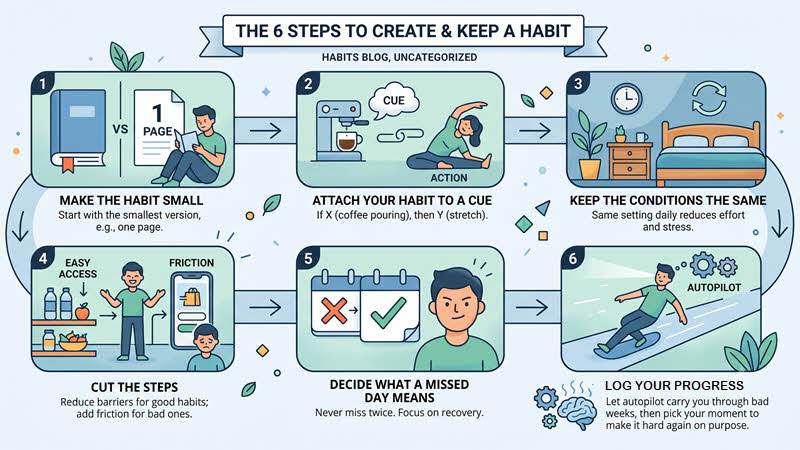
Here is how to use this for yourself. Pick one thing you keep meaning to do and keep failing at. Identify the channel your wrong self uses to win: the phone in your hand at eleven p.m., the browser tab open behind the document, the snack cupboard at four, the half-hour gap between dinner and the work you said you’d do tonight. Build the wall in that specific channel — not a general resolution, but a physical or digital block in the exact place your future self will reach. The phone in a kitchen safe with a timer lock. The Cold Turkey session set yesterday for tomorrow morning. The food not bought on Saturday so it isn’t in the cupboard on Tuesday. The 9 a.m. calendar block that’s automatic and recurring.
And make it cost something to break. If the price of failing is “feel a little bad,” your eleven-p.m. self will pay it without thinking. The wall has to hurt to climb.
Most people manage their evenings, their savings, their phones with a thousand small acts of will that lose ground every hour. Allende manages hers with one date, one room, one candle. She has made herself, in the part of her life that matters most, a person easier to predict than to negotiate with.
The door is closed. Yours can be too. Pick your January 8.
Resources
- David Epstein, “The Secret to Success Is Monotasking,” Atlantic excerpt from Inside the Box, 2026. https://kottke.org/26/05/0048854-the-secret-to-success-is Relevance: Originating source for the Allende anecdote, the closed-door quote, and the publication-cadence figures. Used for: Opening section, January 8 close.
- Wikipedia, “Isabel Allende.” https://en.wikipedia.org/wiki/Isabel_Allende Relevance: Confirms the January 8, 1981 origin date and the letter-to-grandfather backstory of The House of the Spirits. Used for: Opening.
- Omega Institute, “Writing Rituals” interview with Isabel Allende. https://www.eomega.org/article/writing-rituals Relevance: Allende’s own description of the candle ritual and the closed-door discipline. Used for: Opening and close.
- Thomas Schelling, The Strategy of Conflict (1960); Schelling Econlib biography. https://www.econlib.org/library/Enc/bios/Schelling.html Relevance: Originator of the modern game-theoretic concept of commitment and the “collection of selves” framing. Used for: “The two selves” section.
- Jon Elster, Ulysses and the Sirens (Cambridge UP, 1979). https://www.cambridge.org/us/academic/subjects/philosophy/philosophy-general-interest/ulysses-and-sirens-studies-rationality-and-irrationality Relevance: Formalised the philosophical concept of precommitment and gave the literature its naming convention. Used for: “The two selves” section.
- Wikipedia, “Ulysses pact.” https://en.wikipedia.org/wiki/Ulysses_pact Relevance: Canonical description of the Homer source material and the modern application to psychiatric advance directives. Used for: “The two selves” and “The break-glass case” sections.
- Mayo Oshin, “Victor Hugo’s House Arrest Strategy.” https://www.mayooshin.com/victor-hugo-how-to-beat-procrastination Relevance: The Hugo deadline timeline and the 1,000 francs-per-week penalty, sourced to Adèle Hugo’s memoir. Used for: “The shawl” section.
- languor.us, “The Victor Hugo working naked story: myth or fact?” https://languor.us/victor-hugo-working-naked-story-myth-or-fact Relevance: Careful sourcing of the shawl-and-locked-clothes anecdote and correction of the popular “naked” myth. Used for: “The shawl” section.
- Nava Ashraf, Dean Karlan, Wesley Yin, “Tying Odysseus to the Mast,” QJE 121(2), 2006. https://academic.oup.com/qje/article-abstract/121/2/635/1884033 Relevance: The 81% savings increase from the Philippines SEED experiment. Used for: “Tying Odysseus to the mast” section.
- Xavier Giné, Dean Karlan, Jonathan Zinman, “Put Your Money Where Your Butt Is,” AEJ: Applied Economics, 2010. https://www.aeaweb.org/articles?id=10.1257/app.2.4.213 Relevance: The 11% take-up, 3 pp improvement at 6 months, persistence at 12 months for the CARES smoking program. Used for: “Tying Odysseus to the mast” section.
- J-PAL, “CARES Commitment Savings for Smoking Cessation in the Philippines.” https://www.povertyactionlab.org/evaluation/cares-commitment-savings-smoking-cessation-philippines Relevance: The 66% failure rate among CARES contract-takers, used in the complication section. Used for: “What the literature does not say” section.
- StickK / Accountablo, “Apps That Charge You Money When You Fail.” https://www.accountablo.com/blog/apps-that-charge-you-money Relevance: The 78% vs 35% success-rate comparison and the $69 million cumulative stake figure. Used for: “Tying Odysseus to the mast” section.
- Anett John, “When Commitment Fails: Evidence from a Field Experiment,” 2018. https://economics.yale.edu/sites/default/files/john_when_commitment_fails_march2018.pdf Relevance: The strongest single piece of evidence that commitment devices regularly leave their users worse off. Used for: “What the literature does not say” section.
- TechCrunch, “The best distraction blockers to jump-start your focus.” https://techcrunch.com/2025/12/25/the-best-distraction-blockers-to-jumpstart-your-focus-in-the-new-year/ Relevance: The setup of Cold Turkey’s “Frozen Turkey” lockdown mode and Freedom’s locked sessions. Used for: “Tying Odysseus to the mast” section.
- Wikipedia, “Hernán Cortés.” https://en.wikipedia.org/wiki/Hern%C3%A1n_Cort%C3%A9s Relevance: Confirms the 1519 scuttling at Veracruz, used briefly in the moral-inertness complication. Used for: “What the literature does not say” section.


Leave feedback about this