


Motivation follows rules that most workplaces and classrooms still ignore. This article draws on Daniel Pink’s Drive and self-determination theory to show how to start, and how to keep going.
No more carrots and sticks
In the 1960s, psychologist Sam Glucksberg sat people down in front of a candle, a box of tacks and matches, then asked them to fix the candle to the wall so the wax wouldn’t drip on the table.
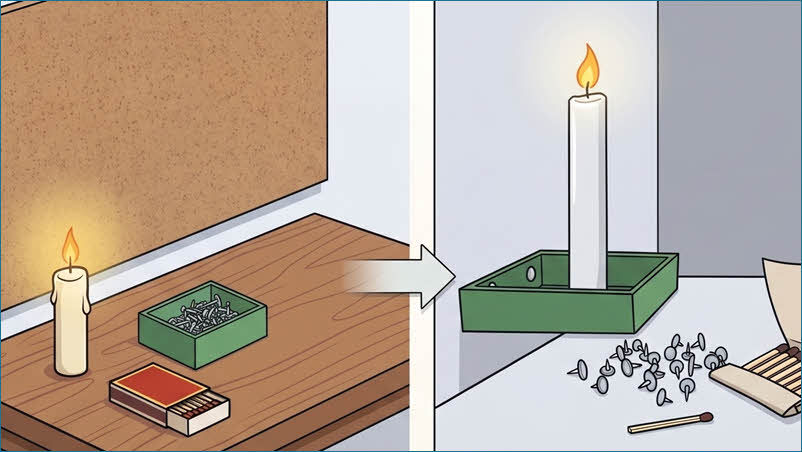
The solution requires a small mental leap. Empty the box, tack it to the wall and use it as a shelf to place the candle on.
Glucksberg offered one group cash for fast solutions. That group took 3.5 minutes longer than the group working for nothing.
The reward dulled thinking instead of sharpening it, and decades of research since have confirmed the pattern. If-then rewards (“if you hit the target, then you get the bonus”) work for simple, mechanical tasks with short time horizons. For complex, creative work, however, they often backfire.
Which raises the practical question: If bribes and threats won’t get you moving or keep you going, what will?
Rewards can kill your motivation
Stanford psychologist Mark Lepper ran an experiment in 1973 with preschoolers who loved to draw. One group was promised an award for drawing. A second group drew and received a surprise award afterward. A third drew with no prize at all. Two weeks later, during free play, the surprise-award kids and the no-award kids drew as much as ever. The kids who had drawn for the promised prize had lost interest.
Only one condition damaged their motivation, and it was knowing about the reward in advance. Once drawing became a means to an end, it stopped being something they did because they loved it.
Psychologists call this the overjustification effect, and it shows up in adults too. When the reward becomes the reason for the work, the work loses its own pull.
This doesn’t make pay irrelevant. People need to be paid fairly, and when they aren’t, motivation collapses and nothing else will fix it. Variable pay can work when it stays simple, hard to game, and tied to outcomes that matter. The trouble starts when compensation schemes grow so elaborate that people work the scheme instead of the job.
So the first move in getting motivated is subtraction. Look at the if-then rewards you’ve attached to your own creative work and remove one.
Motivation runs on 3 psychological needs
The self-determination theory claims that human motivation depends on 3 basic psychological needs. Think of them as the CAR you need for your drive.
When these needs are fed, you develop self-determined motivation and do your best work.
When the needs are starved or blocked, people slide toward two worse states. One is controlled motivation, grinding through tasks for external reasons. The other is amotivation, the flat absence of any impulse to act at all.
A 2022 study of undergraduates about academic procrastination found that students whose autonomy, competence or relatedness were actively blocked predicted amotivation strongly. Amotivation, in turn, is a reliable predictor of procrastination.
That insight matters for anyone trying to “get motivated.” You don’t install motivation in yourself the way you install an app. You create the conditions under which it grows, and the conditions are the 3 psychological needs.
1. To get started give yourself autonomy
Autonomy is the entry point, and Daniel H. Pink breaks autonomy into four T’s in his book Drive:
Gaining autonomy over even one of these lifts your motivation, because with no control you would either have to comply or defy. Neither is engagement.
The remote-work shift made this visible. For decades managers insisted people couldn’t handle that much freedom. Then hundreds of millions of workers handled it fine. Control gets compliance, autonomy gets commitment.
The research points the same direction. A 2022 study found that students in a need-supportive learning environment showed lower amotivation than students in a standard one, and that feeling incompetent or controlled fed amotivation directly. A 2024 study found that parental autonomy support raised adolescents’ need satisfaction, which raised self-control and intrinsic motivation.
Exercise
Do an autonomy audit on yourself. Rate your current work from 1 to 10 on each of the four T’s. The lowest score marks where your motivation is leaking, and it tells you which conversation to have with your manager, or with yourself.
2. To stay motivated make progress visible
Autonomy gets you started. What keeps you going is competence, which you experience as progress. Harvard’s Teresa Amabile analysed nearly 12,000 daily diary entries from knowledge workers and found that the single biggest day-to-day motivator was making progress in meaningful work. Small wins counted. What she calls the progress principle held even when the steps forward were minor.
Pink folds this into what he calls mastery, and he gives it three laws:
Exercise
The daily practice that follows from this research takes only 60 seconds. At the end of each day, write down 3 ways you made progress, however small. Seeing the progress creates momentum, and momentum is what mastery feels like from the inside on an ordinary day.
3. Borrow motivation from meaning
Much of life is not inherently enjoyable, and self-determination theory has an answer for that too. Extrinsic motivation is external regulation, working for a reward or to dodge a punishment. Further along sits identified regulation, where you do the task because you see its personal value, and integrated regulation, where the task has folded into your identity.
Purpose is the fastest route to internalisation. In a field experiment at a university dining hall, researchers let cooks and customers see each other through a live video link. Same pay, same recipes, same hours. Satisfaction with the food climbed more than 20% above baseline when both sides could see each other. The cooks now saw who they were cooking for.
Exercise
Run the same experiment on a smaller scale. Next time you’re stuck on a report, a meeting, or a supplier dispute, stop asking how to do it and ask why it exists in the first place, and name the specific person it serves. The task doesn’t get easier, but you get motivated in the right way.
The bottom line
There’s a tragic mismatch between what science knows and what we actually do to get motivated, and the gap is yours to exploit. This week, remove one if-then reward from your work or studies that requires thinking. Raise your score on one of the four T’s. Write down 3 daily wins. Ask one honest why.
Motivation arrives on its own once you set the conditions, and no manager, teacher, or app can install it for you.
Frequently asked questions
Shrink the task until progress is visible, then start. Teresa Amabile’s diary research (https://hbr.org/2011/05/the-power-of-small-wins) found that small wins in meaningful work are the strongest daily motivator, so one completed step beats an hour of psyching yourself up. Pair it with a why. Naming the person the task serves raises effort and quality.
Yes, for simple, mechanical tasks with clear steps and short timelines. Fair baseline pay is also a precondition for any motivation at all. Rewards fail on complex, creative work, where promised if-then incentives narrow thinking and can erase existing interest, as Mark Lepper’s 1973 drawing study showed (https://doi.org/10.1037/h0035519).
Self-determination theory (https://selfdeterminationtheory.org/theory/) names autonomy (feeling you act by choice), competence (feeling effective and improving), and relatedness (feeling connected to others). When all 3 are satisfied, people develop durable, self-driven motivation. When they’re frustrated, motivation degrades into compliance or disappears into amotivation.
Amotivation is the complete absence of intent to act, driven by seeing no value in the task, feeling incapable, or believing the outcome is out of reach. It predicts procrastination, disengagement, and psychological distress, so it needs direct treatment. Restoring a sense of value, capability, or connection works better than pep talks.
Pink’s Drive (https://www.danpink.com/books/drive/) is a popular translation of Deci and Ryan’s academic framework. Autonomy maps directly, mastery corresponds to competence, and purpose overlaps with relatedness plus the perceived value of the work. The practical advice is compatible in both frameworks. Feed the needs and motivation follows.
Leave feedback about this