


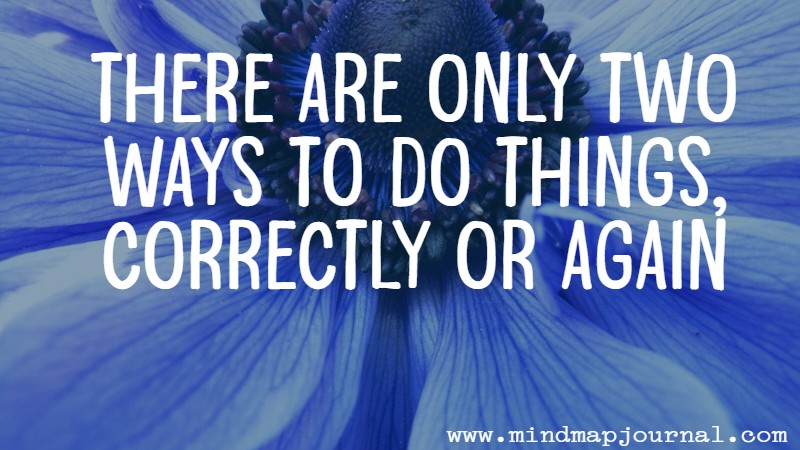
Learning requires confusion and repetition. Do it again if you fail or a little different if you succeed, and you become unstoppable.
The Mind Map Journal
The meaning of the quote
Picture someone learning to skateboard. The first time they push off, they fall. The second time, they wobble but stay upright for three seconds longer. By the 20th try, their body starts making tiny corrections before their brain even catches up. Nobody taught them the physics of balance. They found it by falling, noticing what changed, and trying again.
The quote is describing exactly that loop. Confusion is the falling part, that moment a skill or an idea doesn’t yet make sense, and your brain has to sit in that discomfort instead of bailing out. Repetition is the trying again; not blind repetition, but repetition with a small adjustment each time: a little different if it worked, again if it didn’t. Put those two together often enough, and you get the third thing the quote promises: someone who’s hard to stop, because they’ve built the habit of turning failure into information instead of a reason to quit.
This matches what cognitive scientists have found when they study how people retain skills and knowledge. In Make It Stick, Peter C. Brown and his co-authors lay out research showing that struggling to retrieve an answer, even getting it wrong at first, builds stronger memory than being handed the answer smoothly.
Confusion isn’t a sign you’re doing it wrong. It’s often a sign your brain is doing the hard work that makes the lesson stick.
Most people avoid that discomfort on instinct. Confusion feels like failure, so the easier move is to stop, watch someone else do it, or pick something you’re already good at instead. That’s why so few people stay unstoppable at anything for long, not because they lack talent, but because they exit the loop the moment it gets uncomfortable, right before the repetition would have paid off.
Try this
- Pick one skill you’re currently bad at
It could a language, an instrument, a sport, a game. Practice it for fifteen minutes a day for a week. Don’t aim to be good. Aim to notice exactly where the confusion shows up each time. - After each session, write one sentence
Write down what failed, and what you’ll change next time. Not “I need to practice more”. No write something specific, like “I keep rushing the second verse, so tomorrow I’ll play it at half speed.” - Then Evaluate and Compare
At the end of the week, compare day one to day seven. The gap between them is the quote, made visible.
The next time confusion shows up while you’re learning something, take it as a sign you’re in the right place, not the wrong one. Adjust, go again, and let repetition do what it’s supposed to do.
Resources
- Make It Stick by Peter C. Brown (Book summary, on why confusion and effortful retrieval build stronger learning)
- Make It Stick: The Science of Successful Learning (Book
- Repetition and Learning (Article, on why repetition alone isn’t enough without retrieval and adjustment)


Leave feedback about this