







AI is changing how we read, but using it as a replacement for deep reading makes you a weaker thinker. The smartest approach combines both.
AI is changing how we read
You’ve probably pasted an article into ChatGPT and asked for “the key takeaways.” Skimmed the response, nodded, and moved on, feeling like you understood the piece. But that’s a feature of how your brain responds to fluency. When something reads smoothly, your mind assumes you’ve grasped it. Psychologists call this the fluency illusion, and AI summaries trigger it constantly.
The problem is using AI as a replacement for reading instead of a partner in it.
Dr. Maryanne Wolf has spent decades studying what she calls the “reading brain,” and her work reveals something most people never consider. Reading isn’t natural. Unlike speech or vision, which are hardwired into our biology, reading is a cultural invention. Your brain had to rewire itself to do it. New neural pathways connecting the visual cortex to language and logic centers had to be forged from scratch. That wiring took humanity centuries to develop, and Wolf argues we’re now at a hinge moment where that wiring is being reshaped again.
AI change how we read. Will you let AI make you a weaker thinker, or a sharper one?
The deep reading brain
For 500 years, the dominant mode of reading looked the same: you sat with a book, moved through it sequentially, and submitted to the author’s logic. You couldn’t skip to the answer. You had to walk the path.
When you read deeply, your brain decodes symbols, integrates language and logic, and do analysis and decision-making. This circuit is bidirectional. As your eye moves across a line, your brain isn’t just decoding; it’s predicting what comes next based on syntax, context and prior knowledge.
Wolf describes something she calls the “Proustian moment,” the point where a reader pauses, looks away from the page, and synthesizes the author’s thoughts with their own. That pause is where insight lives. It’s a generative act: the reader goes beyond what’s written and constructs new knowledge.
Neuroimaging studies show that when you engage deeply with a character’s inner world (in fiction or narrative nonfiction), your brain activates the same sensory and motor networks as if you were living those events yourself. Deep reading is, quite literally, a simulation engine for empathy. It builds the ability to understand that other people have beliefs and desires different from your own.
Skimming doesn’t do this. Summaries don’t do this. Only sustained, patient engagement with a text activates these circuits.
The bad news? These circuits operate on a use it or lose it basis. Eye-tracking studies show that digital readers already tend toward an F-shaped scanning pattern, reading the first few lines of a paragraph and then scrolling vertically down the left margin hunting for keywords. When the brain adapts to skim, it reallocates resources away from deep processing. The capacity for understanding complex arguments, recursive logic, and emotional nuance degrades.
That erosion was happening before AI entered the picture.
The new way we read with AI
Generative AI introduces a third reading mode. Not the sustained focus of deep reading. Not the keyword-hunting of skimming. Something different: dialogic reading.
The term “dialogic reading” originally described an educational technique where an adult reads to a child and asks questions to encourage active participation. With AI, the dynamic shifts. The adult reader engages an LLM as a reading partner, feeding it text and asking questions, challenging claims, requesting explanations.
This changes the geometry of reading. The text is no longer a fixed path you walk. You don’t wait for the author to build their argument. You ask: “What’s the conclusion?” or “What are the three weakest points in this argument?” All parts of the text become equidistant. Complex academic prose can be rewritten into plain language with a single prompt.
The speed gains are real. Researchers can upload 50 PDFs and ask which papers contradict the consensus on a given topic. A high school student can engage with PhD-level material by asking the AI to explain concepts using analogies from gaming. Non-native speakers can read fluently by having jargon and idioms translated in real time.
But the cognitive costs are also real.
The fluency illusion problem
A clear AI summary of a difficult text makes you feel like you’ve understood the material. You haven’t. Because you didn’t wrestle with the original syntax, didn’t sit with confusing passages, didn’t do the cognitive heavy lifting, the neural connections you formed are weak and temporary.
Cognitive Load Theory explains why this matters. Learning requires managing three types of load:
AI is excellent at reducing extraneous load. But it often eliminates intrinsic load too, and that’s the load you need. If the AI lifts the weight, your cognitive muscles don’t grow.
Researcher Qirui Ju found that while AI summarization improved the quality of written output, complete reliance on AI for synthesis tasks led to a 25.1% reduction in accuracy on comprehension tests. The knowledge didn’t stick because the cognitive offloading prevented consolidation.
The echo chamber risk
When you drive the reading with questions, you also drive the framing. Ask the AI “Why is this author wrong?” and it will generate arguments against the text. Ask “Why is this author right?” and it will generate support. The AI mirrors your intent rather than challenging it.
Linear reading forces you to confront an author’s full argument, including the parts you’d rather skip. Dialogic reading lets you cherry-pick. You get the “key points” but miss the subtle qualifications, the careful scoping, and the context that defines the limits of a theory.
The hallucination problem
LLMs are probabilistic, not deterministic. They can fabricate plausible-sounding details, especially when summarizing long texts. They also tend to smooth out the edges of ideas, stripping the voice, style, and radical originality from a text and presenting a homogenized version of unique thinking. Build your understanding on a hallucinated summary, and you’ve built on sand.
Long-term learning suffers
A randomized controlled trial with 405 students (ages 14-15) tested three conditions: note-taking alone, note-taking plus LLM, and LLM-only. Three days later, note-taking alone and note-taking plus LLM both outperformed LLM-only on comprehension and retention tests, even though students preferred the LLM condition.
When AI replaces traditional strategies rather than complementing them, long-term learning suffers. Students liked it more but learned less.
The hybrid approach that works
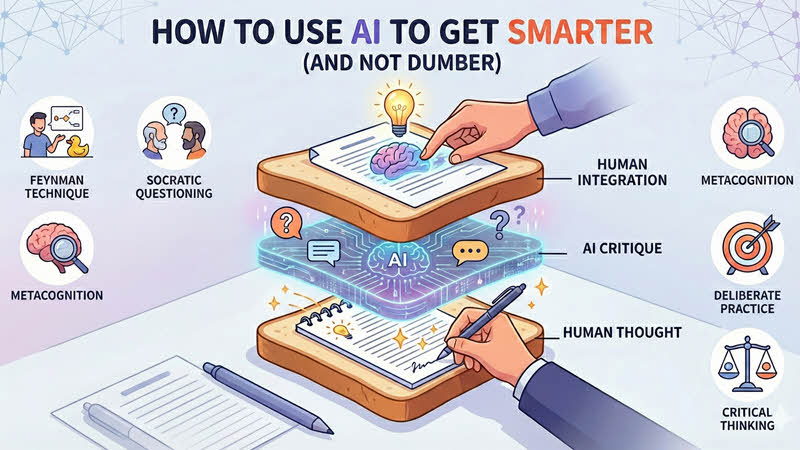
The strongest evidence points toward what you might call “bi-literate” reading: using AI and traditional methods together, each in the situations where it performs best.
The pattern looks like this:
AI handles triage and scaffolding. Use it to decide whether a text deserves your full attention. Use it to translate jargon, build structural outlines, and connect new material to what you already know.
You handle depth and retention. Read the sections that matter linearly. Take structured notes. Sit with confusion instead of immediately outsourcing it. The struggle is the point.
AI handles testing and review. After reading, use it to generate quiz questions, identify gaps in your understanding, and produce retrieval prompts for spaced repetition.
This maps directly to what the research supports.
AI prompts for readers
Most people prompt AI for summaries. That’s the lowest-value use case. The prompts that produce real learning are structured around phases: pre-reading, in-reading, and post-reading.
Phase 1: Pre-reading (Triage and framing)
Before you invest an hour reading a 40-page paper, spend 2 minutes figuring out if it’s worth that hour.
This primes your brain to watch for specific pitfalls while reading.
Phase 2: In-reading (Dialogic exploration)
Paste sections one at a time. Don’t dump the whole document.
Phase 3: Post-reading (Testing and synthesis)
This is where most people stop too early. The reading happened. Now make it stick.
This last one transforms reading from passive download into active social simulation. The emotional engagement of a debate releases dopamine and norepinephrine, which strengthen memory consolidation.
Practical tips for deep reading
Even without AI, you can optimize how you read using well-established cognitive science.
The handwriting-to-digital bridge
One workflow that combines the benefits of both worlds:
Handwriting activates motor memory circuits that typing doesn’t. AI gives you searchability and synthesis that paper can’t. Together, they cover each other’s weaknesses.
The NotebookLM audio scaffold
If you’re facing a dense paper, try this before reading:
This builds a scaffold of the main ideas. When you read the text afterward, your brain isn’t struggling to build the structure from scratch; it’s filling in details on a framework that already exists. Cognitive load drops and comprehension increases.
But listen to the audio before reading, not instead of reading. The scaffold is not the building.
Spaced repetition on autopilot
After finishing a chapter or article, don’t let the AI just summarize. Make it a teacher.
Flashcard generation prompt:
Based on this chapter, generate 15 Anki-compatible flashcards. Focus on ‘Why’ and ‘How’ questions, not just definitions. Output as a CSV.
This automates the creation of long-term memory artifacts. The flashcards test understanding, not recognition. And because they’re generated from the specific text you read, they reinforce the exact neural pathways you built during reading.
Die Quintessenz
The transition from the deep reader to the AI-augmented reader isn’t a decline. It’s a diversification. The danger lies in replacement: letting the ease of AI dialogue atrophy the muscles required for deep processing.
A brain that can only consume AI summaries is a brain that can’t construct its own understanding. It rents prefabricated structures from an algorithm instead of building its own.
But a brain that can toggle between modes, one that uses AI to triage, scaffold and interrogate while reserving protected time for unassisted engagement with texts that matter, that’s a more capable reader than either mode alone could produce.
AI prompts for reading and learning
These prompts are designed to make you a better reader. Each one forces active engagement with the material. Copy them, tweak them for your field, and use them as part of the hybrid workflow described above.
Before you read
While you read
After you read
Each of these prompts has a built-in friction point. They don’t just hand you answers. They make you think, respond and evaluate. That’s the difference between using AI to avoid reading and using AI to read better.

Hinterlasse ein Feedback zu diesem Thema